Automakers and workers face existential fight over robots, future
Published in Business News
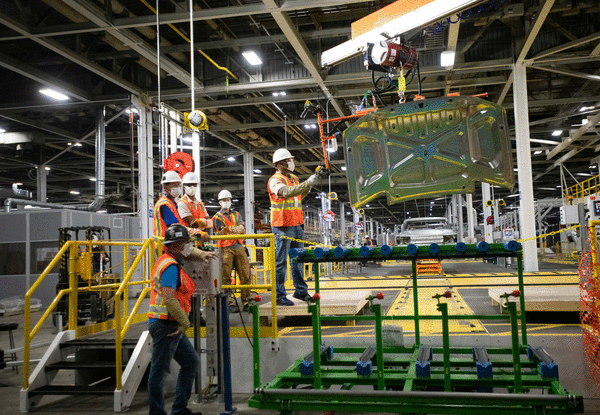
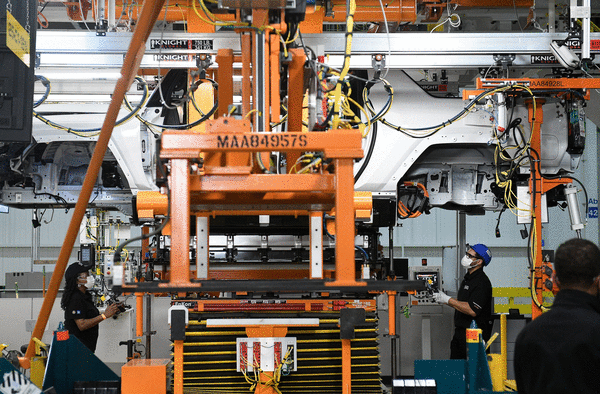
Automakers and workers are teed up for what each side views as a fight for existence — with cobots in the middle and already operating inside General Motors Co's Factory ZERO in Detroit.
Artificial intelligence, robots and automation took center stage in Detroit during this week's UAW Constitutional Convention and Reindustrialize, an industry conference focused on tech, manufacturing and defense. The reason: They're real, not just a theoretical talking point.
For factory workers, cobots — shorthand for "collaborative robots" that work alongside humans — threaten jobs. UAW President Shawn Fain told workers gathered for their convention in this historic union stronghold that artificial intelligence and humanoid robots pose a "profound threat" to their livelihoods and humanity.
"We need to be clear about this: We are in a fight for humanity," Fain said. "The fruits of our labor have multiplied like never before, but workers aren't reaping the harvest. And if AI continues to be used as an accessory to that crime, it has to be stopped. It doesn't have to be this way; in a just society, when workers create more value, they see more of the benefit."
For automakers, cobots and other forms of automation are critical to staying competitive globally, especially against speed-driven China. Both threats are real, said industry research firm AutoForecast Solutions' Vice President Sam Fiorani.
"It is a global market, and we have to be competitive on all levels," Fiorani said. "Unfortunately, that means more automation, and in some cases, fewer humans on the assembly line."
Automakers often point to how robots are used to increase safety, ergonomics and product quality. But experts say another benefit of robots for automakers is keeping labor costs down, meaning fewer jobs for humans.
Five miles from downtown Detroit, dozens of cobots are in place at GM's Factory ZERO plant, potentially foreshadowing a future assembly line staffed with fewer people and more machines.
"We’ve been installing cobots across our manufacturing footprint as part of a broader push to bring more advanced technology into our operations," spokesperson Kevin Kelly said in a statement. "At Factory ZERO, we are implementing them alongside our team — helping improve safety and ergonomics, while keeping our operations flexible and competitive.”
The presence of roughly 50 cobots at Factory ZERO especially stings after GM in late March temporarily laid off 1,300 workers at the electric vehicle plant amid slow sales of battery-powered models, said James Cotton, president of UAW Local 22, which represents workers at the plant.
"We have over 1,000 members that are laid off, laid off indefinitely," Cotton said. "And instead of bringing 50 cobots in, bring some of those members back to work, that's the way we look at it, as a union."
Cotton said he has concerns that GM will continue its automation push in the plant, potentially continuing to impact employment levels. The facility already utilizes unmanned forklifts and tuggers, he said. And he worries more cobots may also be installed soon.
Cotton said he's also concerned about the safety of his members, working so close to the collaborative robots; one of them recently malfunctioned. Existing robotics in the plant are typically walled off from workers, but the cobots are moving parts side-by-side with workers, and in some cases installing components on vehicles.
"Over 1,000 of us were laid off because GM chose to build extravagant luxury EVs, and now they're using these layoffs to install cobots that can take away future work," said Andrew Bergman, a laid-off worker who is a Local 22 member and union organizer.
"Technological development has the capability of making work safer for the working class and enabling workers to have a shorter work week without losing pay. But in the bosses' and billionaires' hands it's used to pad profits and lay off workers."
Hyundai Motor Co.'s new Georgia EV factory uses more than 1,000 robots and automated guided vehicles that will, when fully staffed, eventually work alongside more than 8,000 humans. Among them: robotic dogs named Spot that conduct quality control tasks.
Stellantis NV uses cobots in its North America manufacturing facilities to deliver parts to the assembly line and facilitate operations with high cycle times.
Ford Motor Co. last year announced a $2 billion investment in its Louisville Assembly Plant to build a new $30,000 electric pickup truck. The factory — which Ford says will be its most automated in the world — will include three streamlined sub-assembly lines that incorporate robots and artificial intelligence features, limiting the number of difficult maneuvers that employees must perform to install parts.
"Everybody is working in that direction," Fiorani said. "By not moving towards more automation, you're giving up a competitive advantage to someone else."
Advanced automation is more common in EV plants, Fiorani said, where it's easier to integrate new technologies into the manufacturing process compared to gas-powered vehicle assembly lines that have been fine-tuned for more than 100 years.
Fain this week called on union members to fight company efforts to force a dwindling number of workers to use AI and other automation to "work harder, faster, and longer hours, typically for less money."
Neither Fain nor AFL-CIO President Liz Shuler detailed specific policy plans or bargaining demands about automation during the convention.
Fiorani said cobots could extend assembly line jobs because by definition they work with humans. But full automation is coming, he said: "Eventually, robots will replace human beings on assembly lines all around the world."
©2026 www.detroitnews.com. Visit at detroitnews.com. Distributed by Tribune Content Agency, LLC.










Comments