With rifles and defiance, Hamas clings to remnants of Gaza rule
Published in News & Features
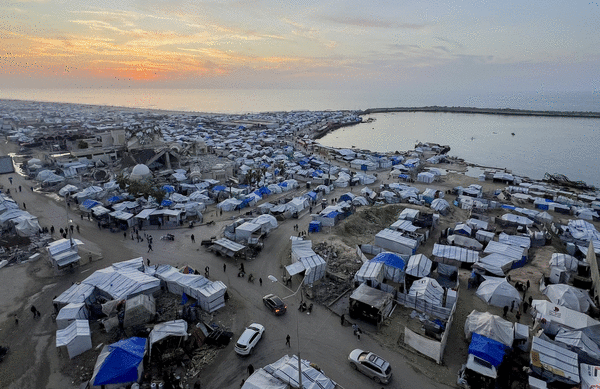
GAZA CITY, Gaza Strip — It’s hemmed in by Israel’s tanks and troops. U.S. President Donald Trump has threatened it with annihilation. But Hamas, defiant in the ruins of less than half of Gaza, is clawing its way back to a semblance of pre-war governance.
Surviving civil servants have returned to work. Taxes are being collected, including from now-homeless Palestinians living in tents. Courts are open for the few who can still afford to bring cases. Hamas functionaries, some of them armed fighters recently reassigned from fighting the Israelis, keep watch at street corners.
The effort underscores Hamas’ refusal to give up all power and weapons as required by Trump’s peace plan, now in the limbo of a first-phase truce. While the Islamist faction can no longer field the mini-army which carried out the Oct. 7, 2023 invasion of south Israel, its rifles give the Trump-envisaged foreign intervention force pause.
“Hamas is taking advantage of delaying the second phase of Trump’s plan by rebuilding its political and security control” in the territory it still controls, said Mkhaimar Abusada, a political science professor at Gaza’s Al-Azhar University who, like many Palestinians with means, emigrated during the war and is currently at Northwestern University in Chicago.
This article is based on interviews with a dozen Gazans living under Hamas rule, including merchants, vendors, restaurant owners, ordinary residents and Hamas officials. The current picture shows how difficult it might prove for the Trump peace plan to advance while Hamas retains its weapons.
Dazed and destitute, the Palestinians who remained often sound resigned to Hamas’ authority. It’s all they have known since the faction won the last Palestinian elections, two decades ago, and cemented supremacy in a 2007 civil war. But in social media and private conversations, complaints abound about a hardening of Hamas methods.
Hamas says it’s trying to cobble together order in the chaos left by two years of war, with occasional Israeli air strikes continuing and shortfalls in humanitarian aid. More than 400 Palestinians have been killed by Israel since the October ceasefire began. Israel says it carries out strikes when it comes under Hamas attack or sees military activity that threatens its forces. Hamas accuses it of violating the truce.
When the ceasefire began on Oct. 10, Hamas raided rival militias and carried out public shootings of Palestinians accused of insurrection or looting.
A Hamas-formed “Petroleum Commission” seized control over distribution of cooking gas, a main source of heating in wintry Gaza. Since then, each Palestinian family has been receiving half-full cylinders, in what Hamas says is an intervention designed to ensure the greatest number benefit from a limited supply. Before the war, cooking gas had been a private market.
Ahmed Shaldan, a Gaza restaurateur, says many businesses like his must pay high sums to what he described as commission “middlemen” for the gas needed to keep their doors open. The commission denied selling gas directly to restaurants.
In Remal neighborhood, once the bustling downtown shopping district of Gaza City, vendors whose stores were bombed by Israel relocated to tents on the main roads. As of last month, the Hamas-run city hall is demanding rent for what it deems tenancy in municipal property.
Maisara Mohammed, a Gaza resident, published on Facebook a screenshot of a message sent by the Hamas-run Land Authority, giving him one week to pay two years of accrued fees. “This is after my house, my apartment and the building I had were destroyed,” he wrote.
Another vendor, who agreed to be identified only by his first name, Ahmed, said he had received a similar demand for 4,200 shekels ($1,320) for the last three months.
“Our livelihoods are shattered,” he said. “Why aren’t they letting us make a living?”
The Land Authority said the text messages were sent by mistake in what it described as a “software error.”
Government departments have resumed operations with “flexible work plans based on crisis management and the rearrangement of priorities,” a Hamas spokesman said.
Before the war, Hamas had 50,000 Palestinians on its payroll. Death, injury, detention and displacement reduced the number by a third. Basic wages are 800 shekels a month — a draw for an overwhelmingly aid-dependent population.
Hamas’ armed wing has been crippled by the loss of senior chiefs in combat. Israel assesses the Iran-backed group’s force-strength at around 20,000 — half the pre-war level, including teenage recruits and junior operatives field-promoted to replace slain commanders.
Hamas “will never give up its arms as long as the occupation continues, and will never surrender even if it has to fight with its nails,” a spokesman for the organization said. It’s designated a terrorist group by the U.S. and European Union.
According to three Hamas members with roles in government or military departments, the faction has placed its gunmen under a more streamlined command structure. They said Hamas is also in the process of choosing a head for its politburo to replace Ismail Haniyeh, assassinated by Israel in Iran in 2024.
Israel wants Hamas’ arsenal stripped entirely under the Gaza demilitarization envisaged by the Trump plan. Hamas has signaled willingness to give up what’s left of its rockets and explosives, but not small arms. It wants a full Israeli withdrawal from Gaza. Other sticking points in proceeding with the Trump plan include Hamas’ failure so far to return the body of the last hostage from the Oct. 7 attack, which Hamas says it’s having trouble locating.
Israeli forces redeployed to the eastern half of the Gaza Strip as part of the ceasefire. The Trump plan calls for them to hand it over to an International Stabilization Force (ISF) meant to help transition to non-Hamas Palestinian rule.
Israel wants assurances that the ISF, whose contributing countries have yet to be decided, will take over the entirety of the Gaza Strip. Since it’s unlikely that any country named to the ISF will want to fight Hamas, that raises the prospect of deadlock in the short term and, unless the faction can be persuaded to relent, a resumed Israeli offensive against it.
“Hamas will give Netanyahu the justification to delay Israeli withdrawal from Gaza,” Abusada said.
_____
©2026 Bloomberg L.P. Visit bloomberg.com. Distributed by Tribune Content Agency, LLC.






Comments