Maduro's legal team is still up in the air a week after arrest
Published in News & Features
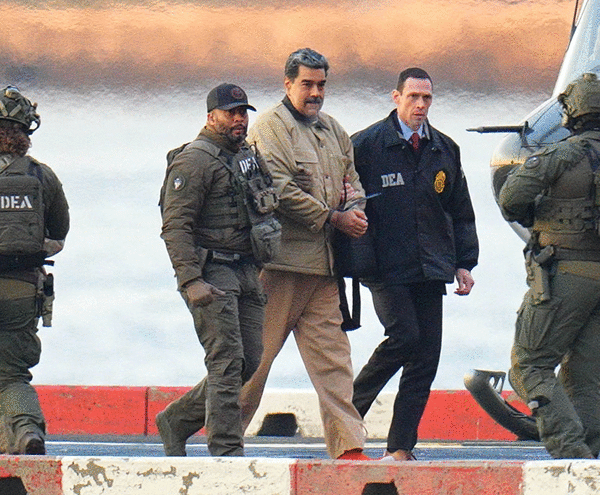

While the world has been consumed by the geopolitical ramifications of the U.S. capture of Venezuelan President Nicolas Maduro, a struggle is playing out over who will represent the ousted leader in his criminal case in New York.
When Maduro and his wife pleaded not guilty in the narco-terrorism case during a brief court appearance Monday, he was represented by Barry Pollack, a veteran Washington defense lawyer whose former clients include WikiLeaks founder Julian Assange.
The next day, another lawyer joined the case, Bruce Fein, a former top Justice Department official during the Reagan administration and prominent constitutional scholar.
But by the end of the week, Pollack was complaining to U.S. District Judge Alvin Hellerstein that Fein had no authorization to act as Maduro’s lawyer — and Fein proposed that the judge hold a hearing to “definitively ascertain President Maduro’s representation wishes.”
The confusion surrounding Maduro’s defense team illustrates both the chaos surrounding Maduro’s seizure and the extraordinary nature of the case against him.
At a time when several of the nation’s biggest law firms have found themselves crossways with President Donald Trump for representing his perceived enemies in the past, Maduro so far isn’t handicapped by attorneys refusing to defend him in one of the blockbuster cases of the decade. And these are early days in a case that could take years to wrap up. It’s not uncommon in high-stakes prosecutions for notorious defendants to wind up with a team of lawyers.
Neither Fein nor Pollack responded to messages seeking comment. Both bring deep experience over decades handling complex cases of international significance.
Pollack oversaw Assange’s 14-year legal matter that culminated in a 2024 plea deal for leaking U.S. national security secrets. Pollack’s other notable past clients include Fugees rapper Prakazrel “Pras” Michel — when he was indicted for his role in a Malaysian financial scandal — and a former Enron Corp. executive whom Pollack got acquitted on fraud charges.
Fein served as associate deputy attorney general and general counsel to the Federal Communications Commission under President Ronald Reagan in the 1980s, and has testified as an expert before Congress more than 200 times. Fein also worked for conservative think tanks including the Heritage Foundation and served as a senior adviser for the 2012 presidential campaign of Ron Paul, who was a Republican congressman in Texas.
In 2013, he served as a legal adviser for Lon Snowden, father of National Security Agency contractor and whistleblower Edward Snowden who was prosecuted for revealing a U.S. government surveillance program that collected phone records of millions of Americans.
Somehow this week, lines of communication between Maduro and his would-be lawyers got crossed.
There was no mention of Fein at Monday’s hearing when Pollack appeared at Maduro’s side in court. Maduro declared “I am innocent” and “I am a decent man,” while Pollack told the judge to expect “voluminous and complicated” filings on behalf of the defense and asserted that Maduro is immune from prosecution as the leader of a sovereign nation.
The next day, the docket reflected Fein’s “notice of appearance” — when an attorney officially informs all involved parties that they are participating in a case.
On Thursday, Pollack wrote to Judge Hellerstein, moving to strike Fein from serving on Maduro’s behalf, saying the Venezuelan president hasn’t retained Fein or “authorized him to hold himself out as Mr. Maduro’s counsel.”
Fein responded Friday, saying in a filing he sought admission to the case “in good faith” based on information from people in Maduro’s “inner circle or family” who indicated the Venezuelan desired to retain him. But Fein acknowledged he did not have direct contact with the ousted president.
Fein asked the judge not to remove him just yet. Instead, he proposed that Hellerstein privately interview Maduro to “dispel any confusion regarding representation and to permit this matter to proceed without detours or distractions unrelated to the merits of the government’s prosecution.”
“President Maduro was apprehended under extraordinary, startling, and viperlike circumstances, including deprivation of liberty, custodial restrictions on communications, and immediate immersion in a foreign criminal process in a foreign tongue, fraught with the potential for misunderstandings or miscommunications,” Fein said in his filing.
As if the confusion over Pollack and Fein wasn’t enough, a third lawyer was also in the mix.
David Wikstrom showed up at Monday’s hearing because he was on a standby list of attorneys dispatched by the court to represent defendants who may not have enough money to hire a lawyer. Wikstrom wrote to Hellerstein afterward to explain that Pollack’s appearance on behalf of Maduro “obviated the need for court-appointed counsel” even though Wikstrom “prepared hastily for the initial appearance and attended it.”
Then he got to the point — he wants to be paid.
“I am unable to claim compensation for the hours I spent working that day unless the court formally appoints me for the initial appearance of Mr. Maduro.”
The case is USA v. Carvajal-Barrios, 1:11-cr-00205, US District Court, Southern District of New York (Manhattan).
———
(With assistance from Benjamin Penn.)
©2026 Bloomberg L.P. Visit bloomberg.com. Distributed by Tribune Content Agency, LLC.




Comments