HUD to try again to change homelessness assistance program
Published in News & Features
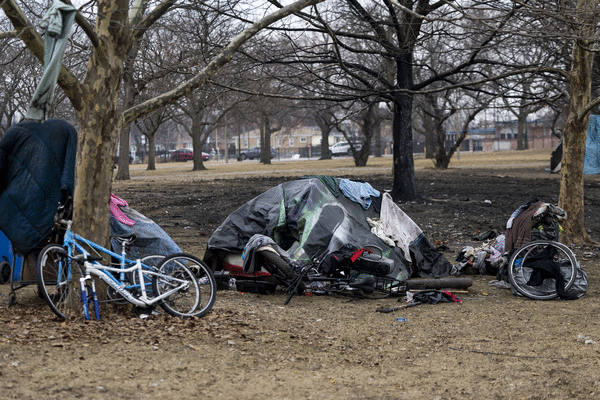
WASHINGTON — The Trump administration will renew its effort to change the approach to the nation’s largest homelessness assistance program with a request for funding that will be released next month.
The Department of Housing and Urban Development said it will publish the 2026 Continuum of Care Notice of Funding Opportunity by June 1. The CoC provides grants to states, local governments and nonprofit organizations that sponsor programs to reduce homelessness.
The department said in a Thursday press release the CoC’s goal is to “optimize self-sufficiency” and increase investment in transitional housing and supportive services, such as street outreach, childcare, outpatient addiction treatment and job training. The grants would fund programs for the 2027 calendar year.
HUD sought to go in the same direction last November, when it issued a CoC request for funding for fiscal 2025 that would have affected programs this year.
Advocates for the homeless and several states sued, and a 1st U.S. Circuit Court of Appeals panel denied the administration’s request that it block a federal court decision stopping HUD from changing how it distributed nearly $4 billion in homelessness grants. The case is ongoing.
HUD’s efforts to modify continuum of care policy are a response to an executive order last July by President Donald Trump titled “Ending Crime and Disorder on American Streets.”
The department criticized a “housing first” approach, taken by the Biden and previous administrations, that provides permanent housing for the homeless before turning to services for drug abuse, mental health and other problems.
“As the number of people living on our streets remains at crisis levels, HUD is committed to reforming its homelessness programs,” the department said in its press release. “The status quo of ‘housing first’ and ‘harm reduction’ has failed at great cost to those suffering on our streets and to working American taxpayers. HUD intends to rebalance the CoC program to focus on a diversity of solutions and treating the underlying causes of homelessness.”
Marcy Thompson, vice president of policy and programs at the National Alliance to End Homelessness, said she is not surprised HUD is trying again to implement the transitional housing policy. The group is the lead plaintiff in one of the suits against the department and advocates for permanent supportive housing.
“It’s disappointing to see the administration move away from evidence-based practices and abdicating their responsibility to respond to homelessness,” Thompson said. “My sense is they’re operating off a lot of assumptions seemingly without taking the time to really understand these programs and projects.”
Congress rejected HUD’s new approach to homelessness policy in the fiscal 2026 Transportation-HUD appropriations law, instead providing CoC funding.
HUD has said it expects to renew grants expiring over the rest of this year. But the individual programs are still in limbo, given lag times between awards and payments, Thompson said.
“The land of the unknown continues to be operating in full swing,” Thompson said.
In its HUD budget request for fiscal 2027, the administration again proposes to eliminate the CoC program. “Instead of continuing to spend billions of dollars on the failed and harmful policies promoted by the administratively burdensome CoC program and unaccountable CoC local boards, the Budget eliminates the program and provides $4 billion for a more targeted Emergency Solutions Grant (ESG) program,” the request states.
©2026 CQ-Roll Call, Inc., All Rights Reserved. Visit cqrollcall.com. Distributed by Tribune Content Agency, LLC.






Comments