Justin Ellis thought his Minneapolis book was done. Then, ICE happened
Published in Books News
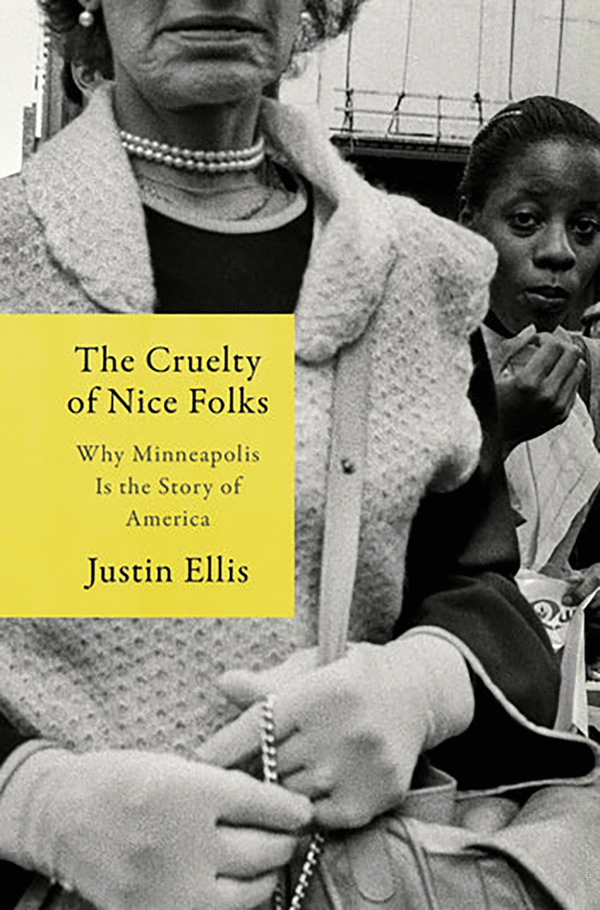
“The Cruelty of Nice Folks” is not about George Floyd but it was inspired by his murder.
South Minneapolis native Justin Ellis’ passionate, elegantly written dive into the history of Minneapolis uncovers a place that’s widely considered liberal, where people say they want to do the right thing but where they repeatedly fall short. Ellis draws attention to the precariousness of being a Black Minnesotan, dating back at least as far as activist Frederick Douglass’ visit in 1873, when he experienced “a sensation all too familiar to being Black in Minnesota: the sense of being alone and in danger in a place so cordial.”
Ellis lives in New York, but he returned to his Minnesota roots during the COVID-19 pandemic to take care of his mother as she received chemotherapy. He wrote about the cordial/cruel disconnect in a story for the Atlantic and editors asked him to expand it into a book. The result, “Cruelty,” is a hybrid that combines Minnesota history with provocative arguments and chapters about his family’s experience of prejudice.
“I really wanted to look at two things: what it was that gave this aura of something like [Floyd’s murder] not being possible in Minneapolis,” the Washburn High School graduate said. “I also wanted to mine the small ways that indifference and hostility have emerged for people who tried to make a life in Minneapolis, look at what it was like to try to have the life that was supposedly guaranteed to people who came to Minnesota. So, not just the history but in some ways, the erasure of history.”
Ellis argues that the roots of that erasure are so deep — at least as deep as the theft of land from Indigenous people — that Minnesotans affected by it don’t even realize it.
“Growing up as a child in the ’80s, by then we’re past racial covenants and redlining. To my eyes, this just seemed like this was the way the city was: Here is where Black families lived and here is where white families lived and here’s where new immigrants coming in would live," said Ellis. “It kind of takes away any villain in the story, any sense of anyone doing something wrong.”
If there is a villain in “Cruelty,” it’s a surprising one: beloved Minnesota politician Hubert H. Humphrey. Ellis gives him his flowers for moving the needle on civil rights but dings the Minneapolis mayor/U.S. senator/vice president for not doing enough.
“It’s his willingness to go out and try to fix inequity with your own hands and with a smile on your face, to reassure the broader white populace while being a useful ally and, at the same time, not recognizing the ways that that might not address all of the needs,” said Ellis, 46. “It’s looking at that kind of politics that has turned into a way of life and how that basically makes it OK for problems to be left unsolved for generations.”
Using historical records and media accounts, as well as his own family’s stories, one thing stuck out to Ellis: “Over the course of the lifetimes of my great-grandmother, my grandmother, my mother and me, it’s the exact same problems that the city seems not to be able to fix.”
Ellis had to be persuaded to include personal details in the book because he didn’t think his story was unique. The inclusion began to make more sense as he spent time with his mom, who died in 2021.
“Even when you see the way society works and even though you know that racism is real and discrimination is real and the schools you attended maybe were not as good as some of the ones in the suburbs, and you know you are much more likely to be pulled over by the police,” said Ellis. “Even then, to think, ‘I don’t know if I have a story to tell,’ that says a lot about being Black in this country.”
One topic “Cruelty” often returns to is policing. Some people’s hopes were raised by Minneapolis City Council members declaring a commitment to “defunding” the police but, ultimately, little changed.
That stasis, which Ellis notes is true in many cities, was one of his biggest struggles in writing the book. His research revealed a cycle of Minneapolis attempting to address key issues, but failing to fix them. Rinse and repeat.
“It didn’t feel real to say, ‘This is how you solve these things,’” said Ellis, a co-owner of media company Defector. “Despite various reports from the state human rights department and the Department of Justice and the city of Minneapolis, various committees and other groups that were funding projects to try to lift up Black families, the results a few years after George Floyd’s death showed that things were pretty much the same.”
Or are they? As “Cruelty” entered final copy editing in January, the world’s attention focused on Operation Metro Surge, particularly the immigration enforcement action’s impact on Minneapolis’ residents. Ellis, who thought he was done with the book, asked for 10 more days to write an epilogue that would cover the city’s response to ICE’s incursion.
Like Bruce Springsteen and those who nominated Minneapolis for the Nobel Peace Prize, that response fueled Ellis’ optimism about the city’s future.
“After so many points in history where it felt like there was opportunity for change but, time after time, the city embraced the status quo, this felt like a time where people said, ‘No. We’re going to try something radically different,’” said Ellis.
In other words, Ellis believes Minneapolis has the latest in a series of opportunities to bring about justice and equality. His book asks: Will it?
____
The Cruelty of Nice Folks: Why Minneapolis Is the Story of America
By: Justin Ellis.
Publisher: Harper, 398 pages.
©2026 The Minnesota Star Tribune. Visit at startribune.com. Distributed by Tribune Content Agency, LLC.










Comments