Commentary: Promoting civic literacy for America's 250th
Published in Op Eds
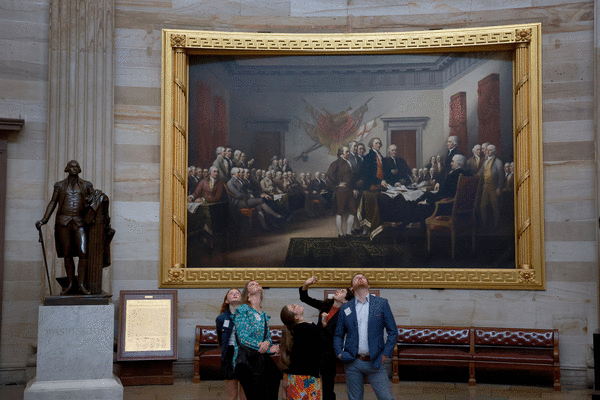
We Americans have always felt anxious about our democracy. As Benjamin Franklin famously said, ours is only “a republic, if you can keep it,” and we’ve been plagued by a nagging feeling ever since that we can’t. The latest bout of handwringing is brought on by declining literacy and the threat it poses to liberal democracy, and—aware of our penchant for anxiety though we may be—it is hard not to feel concerned.
The fact is that we have large and growing numbers of kids who can’t read well. National Assessment of Education Progress scores reveal that the number of students scoring below NAEP basic has grown steadily since 2019. While the percentage of students considered proficient has held steady, decreased literacy is reported even in elite colleges and universities. Adult reading is way down as well.
A host of figures on the Left and Right alike have come forward to call attention to this decline and its connection to self-government: Niall Ferguson warns that “we are rapidly moving to a future where information will be shared via spoken words and images, not text,” thereby undermining our ability “to make sense of the world.” James Marriott contends that “democracy draws immeasurable strength from print with its tendency to foster deep knowledge, logical argument, critical thought, objectivity, and dispassionate engagement,” all of which are threatened by declining literacy.
Both echo the arguments of Adam Garfinkle that ‘deep literacy’—dialectical engagement with an extended text— “is what ultimately allowed Americans to become ‘We the People,’ capable of self-government.” Even Hillary Clinton has joined the chorus arguing against digital media such as TikTok that will lead us to “scroll our way to oblivion.”
As we enter our 250th year as a nation, the centrality of the Declaration of Independence to American identity seems beyond dispute. One poll found that 92 percent believe its principles have been a net force for good in the world. The temple-like structure of the National Archives that houses the original parchment symbolizes the reverence with which we treat this text. But whether, amidst declining literacy, Americans will continue to treat the document and its truths as sacred is in great doubt.
In her book "Our Declaration," Danielle Allen sums up the moral foundation of the document: It does not require a belief in God but instead “a maximally strong commitment to the right of other people to survive and govern themselves…a reason to commit to other people’s survival and freedom so strong as to command one’s reverence. One way or another, one must hold sacred the flourishing of others.”
This strikes me as impossible without a broadly literate population. Not because reading necessarily fosters empathy, which seems suspect given the ample history of brutality among highly literate populations, but because commitment to an abstract truth such as human equality is impossible without the attachment to abstract ideas that deep literacy makes possible.
The blatant inequalities with which humans are endowed are plain to the naked eye. Only the written word provides access to the deeper equality that lies underneath and is the foundation of individual rights held equally by all persons—what Mary Harrington refers to as a “conception of the individual subject as a model of human personhood.” Only biblical religion and the influence of Enlightenment rationality, and the mixing of the two in what James Davison Hunter calls “America’s hybrid-Enlightenment," have proven capable of inspiring sufficient solidarity among us to “hold sacred the flourishing of others.”
As we lose our ability to access abstract truth, equality fades as a foundational principle. Indeed, hierarchy fills the void. Monarchy is a more suitable regime for such a society. We are in real danger of a return to kingship, and it has less to do with political leadership and more to do with the decline of reading.
Harrington notes that “every culture that transitioned from print-first to digital-first ceased, in so doing, to form its population for democratic citizenship.” She argues that monarchy may be the least bad option facing the West in such circumstances. If she’s right, and we may rightly fear that she is, “No Kings” protests belong not in the streets but at the doors of our nation’s schools, colleges, and universities.
____
Thomas Kelly is the vice president and chief program officer at the Jack Miller Center for Teaching America’s Founding Principles and History
_____
©2026 The Fulcrum. Visit at thefulcrum.us. Distributed by Tribune Content Agency, LLC.

































Comments