Colombian presidential candidate seeks Trump's help for war on cocaine gangs
Published in Political News
Colombians face a hard, familiar choice in this month’s presidential election: negotiate with violent criminals, or go back to war against them.
Voters must decide whether to continue President Gustavo Petro’s “Total Peace” strategy, which has brought seven drug-trafficking militias to the negotiating table, even as their leaders get rich from the biggest cocaine boom in history. The alternative is another U.S.-backed military offensive of the kind launched by former president Álvaro Uribe more than two decades ago.
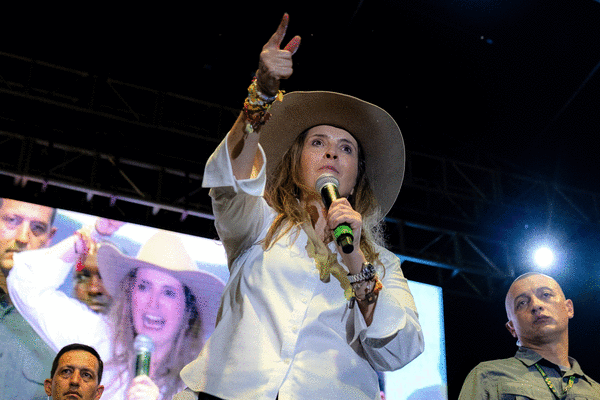
Senator Paloma Valencia, a security hardliner and Uribe protégé, has emerged as one of the most prominent voices calling for an end to talks. Instead, she wants Donald Trump’s help to battle illegal armed groups — an approach that has gained favor elsewhere in the region.
“No Colombian government can sort out the security question unless the U.S. helps us,” Valencia said in an interview during a day of campaigning on the Caribbean coast last month. “Or unless somebody helps us.”
At one campaign event that day, speaking in a sun-baked plaza in downtown Barranquilla, she pledged to hire 60,000 additional police and soldiers and send crime bosses to remote work camps in the sparsely-populated Orinoco basin. Giant “WANTED!” posters of guerrilla leaders, including some she says have plotted to kill her, flashed on a screen behind her.
“We are going to hunt them down,” Valencia, who may become Colombia’s first woman president if elected, told supporters gathered beside a 300-year-old church. “No more impunity or freedom for violent criminals!”
Valencia, 50, has also called on the U.S. to use its influence in neighboring Venezuela to capture guerrilla commanders who have taken refuge there. Colombia’s largest rebel group, the ELN, has most of its senior leadership across the border, according to the Ideas for Peace Foundation.
Uribe’s strategy enabled Colombia to recapture territory from Marxist guerrillas between 2002 and 2010. His approach of seeking U.S. support for a security crackdown is again finding support among some Latin American leaders as Trump rolls out his interventionist foreign policy for the region. In a recent interview, Ecuador’s Daniel Noboa said his security policies draw inspiration from Uribe’s model.
Uribe’s record was also marred by human rights abuses, however. Senator Iván Cepeda — a Petro ally who is Valencia’s strongest rival for the presidency — has spent much of his career documenting those cases and trying to bring the former president to justice.
Colombia recorded 3,391 homicides in the first three months of the year, the highest for the period in more than a decade, while kidnappings have more than tripled since Petro took office in 2022. Cauca province, where Valencia was born, was roiled by a wave of terrorist attacks last month.
The illegal groups have taken advantage of the relative lack of military pressure during talks to expand into new territory, and oversee a surge in cocaine output: Colombia now produces far more of the drug than it did when Medellin cartel boss Pablo Escobar was killed in 1993.
Rising violence boosts Valencia’s appeal — but also that of Abelardo de la Espriella. The lawyer and social media-savvy political outsider has siphoned off some of her core support with a similar tough-on-crime message delivered in more populist language.
Recent polls show that the May 31 election has become a three-way contest, which is likely to head to a June runoff in which either Valencia or de la Espriella will face Cepeda.
Some polls show Valencia defeating Cepeda in runoff, while others suggest he would have an advantage. Most surveys show her performing better than de la Espriella in a hypothetical second round.
Coca economy
Valencia argues that Colombia’s deep economic malaise is being masked by a surge in illicit income from record production of coca, the raw material for making cocaine.
“The national economy is very bad, but people aren’t feeling it because of coca,” she said. “Here, cocaine money is covering it up.”
As her motorcade passed through the working-class district of Soledad, she said Colombia needs growth of at least 5% a year to reduce poverty — roughly double its current pace. The economy hasn’t expanded that quickly in more than a decade, excluding the post-pandemic rebound.
Valencia has pledged to reduce the number of ministries from 19 to 12, rein in spending, cut corporate taxes and eliminate the nation’s wealth tax. The fiscal gap would begin to narrow in the third year of her government, as early investments boost revenue, she says.
She has no immediate plans to reinstate the fiscal rule. This was intended to limit government borrowing, but she says it lost credibility after repeated breaches before Petro’s government suspended it last year.
Like Argentina’s Javier Milei, whom she admires, Valencia said she would seek Washington’s help to refinance Colombia’s debt at lower rates. She predicts that replacing Petro’s administration would trigger a rally in local bonds, driving borrowing costs down from current levels of as much as 14%.
“It’s not that I’m good, it’s that Petro is very bad,” she said. “I believe the market will react euphorically.”
While many investors share Valencia’s assessment of Petro, he retains significant support among working class voters after boosting the minimum wage and overtime pay, as well as welfare payments to millions of poorer Colombians.
Valencia herself is the granddaughter a former president, while her other grandfather founded the country’s top university and was on friendly terms with the physicist Albert Einstein. This privileged background can reduce her appeal for some low-income Colombians.
While campaigning in Barranquilla, she made much of the city’s identity as the hometown of singer Shakira, posing in front of her statue and quoting her songs. But as she left one event, a 72-year-old heckler shouted that she had never experienced hunger. One woman who walked out of her talk with local students muttered: “These are all rich people.”
--------
—With assistance from Philip Sanders.
©2026 Bloomberg L.P. Visit bloomberg.com. Distributed by Tribune Content Agency, LLC.








Comments