Mike Bianchi: Jamahl Mosley didn't deserve to be fired by the Magic -- but that's the NBA way
Published in Basketball
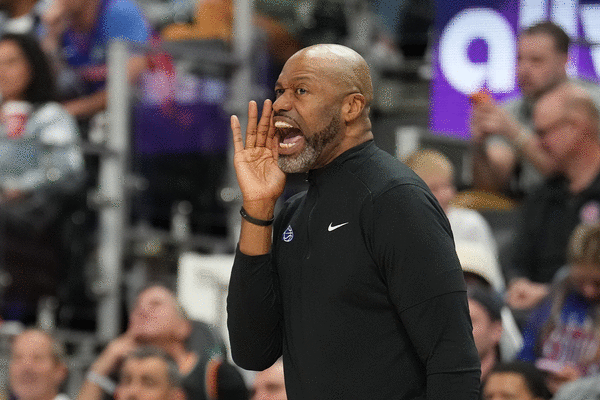
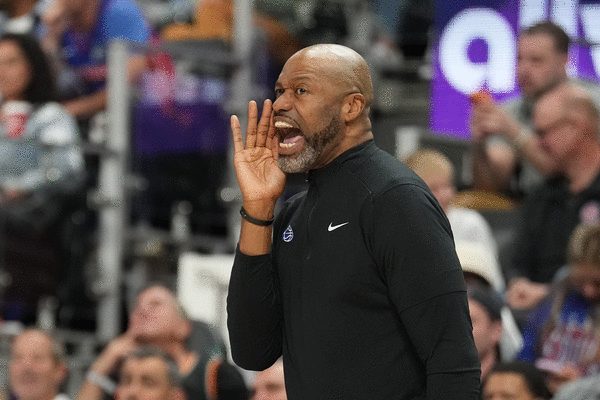
ORLANDO, Fla. — The NBA did what the NBA always does — and Orlando Magic coach Jamahl Mosley knew it was probably coming
Yes, the well-liked and respected “Coach Mose” knew this was how it might end.
He said it before the season ever tipped off, back when optimism still outweighed reality and the Magic still looked like a team on the rise instead of one staring into the familiar abyss.
“As coaches, we know what we sign up for,” Mosley said. “Pressure is a privilege.”
And maybe that’s the cruelest part of all this, because in the NBA, pressure isn’t just a privilege; it’s a countdown clock. When it hits zero, even good coaches — especially good coaches — are the first to go.
So, yes, Mosley has been fired as head coach of the Magic. And, no, it’s not entirely fair. But fairness has never had much to do with how this league operates. Mosley understood that, too.
“We’ve seen coaches that have been extremely successful get let go,” he said before the season. “That’s part of this profession … you have to understand it’s not personal.”
It’s not personal. It just feels like it.
Because if you strip this situation down to its core, Mosley didn’t fail in Orlando. He built something real. He took a franchise buried in irrelevance and guided it to three consecutive playoff appearances; something the organization hadn’t accomplished since Stan Van Gundy was prowling the sidecourt during the Magic’s glory days. He established an identity rooted in defense, toughness and connectivity. He developed Paolo Banchero into a star and helped Franz Wagner evolve into the team’s most complete player.
And when this roster was actually healthy, the Magic didn’t just look competitive; they looked like a legitimate contender.
The numbers back that up. When Orlando deployed its preferred lineup of Jalen Suggs, Desmond Bane, Wagner, Banchero and Wendell Carter Jr., the team outscored opponents by 11.6 points per 100 possessions and defended at an elite level. That’s not a coincidence; it’s a glimpse of what this team was supposed to be.
The problem is they were almost never healthy enough to sustain it.
Injuries weren’t just a subplot; they were the defining theme of the season. Wagner, Suggs and Banchero all missed significant time, and that core five-man lineup played together in only 19 games all year. For a team still trying to figure out how all its pieces fit together, that lack of continuity mattered.
And then came the moment that changed everything:
Wagner’s calf injury in Game 4 against Detroit.
Before that injury, the Magic were up 3-1 in the series and in control. Wagner’s presence as the primary defender on Cade Cunningham mattered, even if it didn’t always show up in the box score. Cunningham was scoring, but he wasn’t efficient. He wasn’t comfortable.
Once Wagner went down, everything flipped. Cunningham found rhythm, confidence and space. In the final three games of the series without Wagner, Cunningham averaged more than 36 points while shooting 51.6% from the field and 61% from 3-point range.
The Pistons surged. The Magic unraveled.
And Mosley’s fate was effectively sealed.
Don’t kid yourself, if Wagner doesn’t get hurt, the Magic win the series. And if they win the series, Mosley is still the head coach today.
It really is that simple.
But simple doesn’t mean fair.
What followed Wagner’s injury wasn’t just a loss; it was a collapse that will be replayed in Orlando for years. In Game 6, with a chance to close out the series at home, the Magic turned into a disaster of historic proportions. They led by 24 points in the second half and then completely fell apart, getting outscored 55-19 after halftime, missing 23 consecutive shots and finishing with just 19 points in the half — the lowest total in playoff history.
In that moment, the Magic didn’t just lose control of the series; they lost control of the narrative.
For two days, they became a punchline. The viral JFK meme — an AI-generated image of a gray-haired, still-living John F. Kennedy with the caption, “JFK if the Orlando Magic was the shooter” — captured just how absurdly inept the offense had become. The meme was dark, ridiculous and painfully accurate.
By the time Game 7 tipped off, the outcome felt inevitable. Detroit played with confidence and clarity, while Orlando looked like a team still haunted by what had happened 48 hours earlier. The result — a decisive loss — felt like the natural conclusion to a collapse that had already happened.
And in the NBA, when a season ends like that, someone has to answer for it.
It’s rarely the front office. Team president Jeff Weltman, after all, signed a contract extension earlier this season. And it’s never the franchise players — Banchero, Wagner, Suggs and Bane — all whom have have lucrative, longterm, fully guaranteed nine-figure contracts.
That leaves the coach.
That’s how this league works.
And, yet, if you’re assigning blame honestly, coaching probably ranks lower than most of the other issues this team faced. The Magic’s roster construction remains flawed. They struggle to shoot in a shooter’s league and still rank near the bottom of the league in 3-point accuracy. The depth is questionable. At one point in the second half of Game 7, Banchero was on the floor with four other players who had a combined no buckets and one free throw. And you wonder why the Magic are a combined 1-7 in playoffs when Paolo scores 30 points or more?
That’s not to say Mosley is above criticism. The Game 6 meltdown will follow him, and questions about in-game adjustments, particularly on the offensive end, are fair. But the idea that he was the primary problem — or that his removal suddenly unlocks this roster — oversimplifies a much more complicated reality.
What Mosley needed — and never consistently had — was a fully healthy roster at the right time. When he did, even in small samples, the results were convincing.
Mosley didn’t lose his job solely because of what happened; he lost it because of when it happened. Up 3-1. Up 24. One half away from changing the narrative entirely. Instead, everything collapsed, and in the NBA, those moments carry disproportionate weight.
It certainly doesn’t help when the Magic’s star player really didn’t seem fully bought in to Mosley’s coaching acumen.
When asked if this team is good enough to get to the next level, Banchero didn’t sugarcoat it after the Game 7 loss to the Pistons.
“You know, I want to say yes, but we haven’t been out of the first round,” he replied. “So if you’re going off the last three years, the answer is no. The last three years we’ve had the same result. So that’s your answer.”
When asked what it’s going to take for the Magic to get to the next level, Banchero replied bluntly: “You create an environment where losing isn’t acceptable … It shouldn’t be comfortable in the building. It should be everybody on their P’s and Q’s feeling pressure to be great, because this result is not good enough.”
Still, this won’t be the end of Mosley’s story as a head coach. Around the league, he is respected for his leadership, his ability to connect with players and his track record of development. Those qualities matter, and they travel. There are organizations looking for exactly what he brings, and it would be surprising if he’s not back on an NBA sideline as a head coach sooner rather than later.
Because that’s the other truth about this league.
Good coaches don’t stay unemployed for long.
Mosley said it himself months ago: you do everything you can, you look in the mirror, and then you “let the chips fall where they may.”
The chips have fallen.
And they landed exactly where they so often do in the NBA:
At the feet of the coach — whether he deserved it or not.
____
©2026 Orlando Sentinel. Visit orlandosentinel.com. Distributed by Tribune Content Agency, LLC.




Comments