USA vs. Australia World Cup match spotlights politics of soccer fandom
Published in Soccer
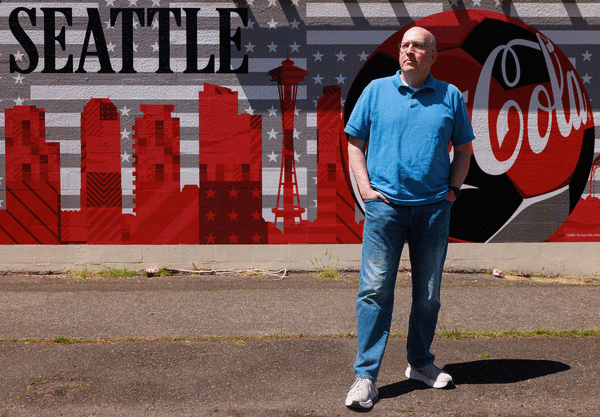
SEATTLE — When Carey Lefkowitz first heard the U.S. men’s national team was going to play a World Cup soccer game in Seattle, he felt a surge of excitement.
The West Seattle marketing consultant loves how the legendary tournament brings fans from different countries together. He’s followed the U.S. team since 1994, when the FIFA Men’s World Cup last played on U.S. fields.
But now that the 2026 edition is actually kicking off, including a match Friday between the U.S. and Australia at Seattle Stadium, Lefkowitz is struggling to separate his love for U.S. soccer from his negative feelings about high ticket prices, President Donald Trump’s crackdown on immigrants and Trump’s war with Iran, among other things, he said in an interview last month.
On one hand, it’s hard for the 47-year-old to imagine not watching the World Cup and rooting for the U.S. players, who hail from diverse backgrounds and have compelling life stories. He wants them to succeed.
On the other hand, it’s hard for Lefkowitz to imagine enthusiastically cheering against their opponents, because he thinks Trump is tarnishing what it means to be American on the global stage.
“It’s not how I expected to feel” about the World Cup, he said a few weeks before the tournament. “I still want the U.S. team to win, but everything that goes with that? I’m conflicted.”
These are questions that many people are pondering in Seattle, an internationally oriented, soccer-impassioned city dominated by Democrats who vehemently disagree with how the Trump administration is running the U.S. and hosting the World Cup.
“I’m an American and very proud of the freedoms we have,” Lefkowitz said. “But I can’t lose my humanity and that’s what I see as happening.”
Not everyone is ambivalent. Some local soccer fans say current affairs actually won’t affect their approach to this summer’s tournament at all. They see sports as an escape from politics and the World Cup as an opportunity for Americans with disparate perspectives to unite behind a single cause.
Although Mark Cairns doesn’t like Trump, “I would root for the U.S. regardless, unless we became a communist country or something,” said the Leschi business owner, who traveled to Los Angeles for the team’s opening win against Paraguay and has a ticket to Friday’s game against Australia.
“It kind of pisses me off when I see people disrespecting the flag,” added Cairns, 58, a lifelong soccer player whose favorite U.S. star is gritty, New York-raised midfielder Tyler Adams. “I’m going to support (the team) 100 percent.”
Dana Bracht, from Lake Forest Park, agreed, writing in response to a Seattle Times callout last month: “This is about athletes and teams, NOT about politics.” Bracht, a former youth soccer coach, thinks of sports as sacred and the World Cup soccer players as “kids,” considering most are pretty young (the average age for U.S. players is 26), rather than political figures, she said.
But it’s not surprising that many other fans are dealing with complex emotions around the World Cup, said Sebastian Mayer, a University of Washington politics lecturer who teaches a class on sports and politics.
“Sports are always political,” especially during a tournament like the World Cup that matches national teams against each other, he said.
Since the World Cup began almost 100 years ago, many host-country leaders have used it to promote their political agendas and “sportswash” their reputations, said Mayer, 33, mentioning tournaments hosted by Argentina’s brutal military junta in 1978 and Qatar’s repressive regime in 2022.
There are politics coming into this World Cup, as well. Trump accepted a “peace prize” from FIFA last year. His administration has barred the Iran team from staying more than 48 hours at a time in the U.S. and has denied entry to a referee from Somalia. Meanwhile, some Iranian Americans are protesting the Iran team as a tool of the Islamic Republic regime.
Trump phoned the U.S. soccer squad before their 4-1 defeat of Paraguay, like he phoned the U.S. men’s hockey team after they won a gold medal at the recent Winter Olympics. In that case, he made a joke about the women’s hockey team and FBI Director Kash Patel chugged a beer in a locker room scene that went viral on social media, drawing criticism from some fans.
“It will be interesting to see how liberal Seattle grapples with something like that,” said Mayer, who grew up playing and watching soccer in Germany and whose partner is Colombian-British-American.
To make matters more complicated, the context is constantly changing. The U.S. team’s fun, free-flowing performance against Paraguay has imbued some supporters with new hope. Trump announced an agreement with Iran on Monday that could end months of war. In the meantime, local fans are navigating this summer’s World Cup politics in various ways.
Ken Langner will be pulling for England because he enjoys watching the English club soccer league and has some English ancestry, he said last month. But he can’t afford tickets to the matches at Seattle Stadium, typically Lumen Field, and — as a progressive who believes his taxes should be spent on healthcare, not bombs — he said he can’t bring himself to fully back a U.S. squad in this moment.
“I can’t do it,” said Langer, 69, a retired Boeing manager who has replaced the American flag he once flew outside his Everett house with a Manchester United soccer club flag. “We used to be the good guys. Now we’re not.”
While Claire Fenton always roots for the U.S. soccer men, she saves most of her money and energy for the U.S. women, partly because she hears players on the women’s team speaking out more about issues like equality.
“It makes me feel better about supporting them,” said Fenton, 46, from Greenwood, who traveled with her family to Australia and New Zealand for the 2023 women’s World Cup.
Brent Fawns will try to reconcile his mixed feelings about soccer politics by focusing his fandom on Cristian Roldan, a Seattle Sounders stalwart with immigrant parents who will be part of a multiethnic, multilingual U.S. roster.
“I will yell for him definitely,” said Fawns, 62, a Sounders supporter who lives in the Central District and has been appalled by Trump’s deportation push.
Evan Williamson, 19, is also looking to the U.S. players for inspiration, precisely because he feels so let down by the politicians running the country.
Maybe they can show everyone what it really means to be American, said the college student from Seattle who plays soccer recreationally.
“They could represent the ideal America,” Williamson said. “Show the strength in our diversity and the freedom we show to the rest of the world.”
Sebastian Diaz, a naturalized U.S. citizen from Colombia who runs the South End soccer nonprofit Cultures United, will root for the U.S. and Colombia.
If they face off in a knockout game, however, Diaz will back Colombia, the 33-year-old said, partly because of how the U.S. government has been operating.
A Peruvian American who organizes pickup soccer games in West Seattle, Fio Bazo is adopting a similar approach. She’s turned off by the corporate side of the World Cup and by the possibility that soccer could help the U.S. government scrub its image after carnage in Gaza and other wrongs.
But Bazo, 43, is at the same time excited for the “giant world party” that the tournament will bring to town. She’ll definitely be tuning in.
“If you’re a soccer fan and you love it, it’s irrational,” so you can’t not watch, she said. “It’s also situational. If the U.S. plays Germany, of course I’m going to root for the U.S. But if it’s the U.S. against a small country where soccer is the biggest joy in their culture, I’m going to root for the small country.”
©2026 The Seattle Times. Visit seattletimes.com. Distributed by Tribune Content Agency, LLC.






Comments