Gov. Jared Polis relies on 'super-secret memo' to back private investment bill in Colorado Legislature
Published in News & Features
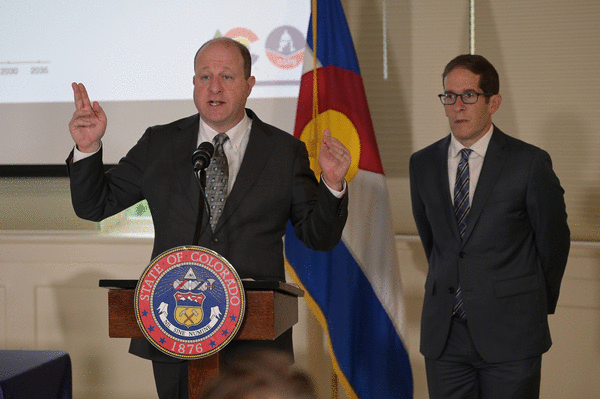
DENVER — Gov. Jared Polis’ office is pursuing legislation that would allow state agencies to invest enterprise fees and other public money in privately managed investment funds, instead of investing through the Colorado treasurer — and it’s relying on what a lawmaker called a “super-secret memo” for legal backing.
The memo to the governor’s office, which is based on a legal analysis by the attorney general’s office, states that there is legal cover for such a move. But a separate public attorney general opinion states that the “plain text” of the Colorado Constitution “generally prohibits the State from directly owning stock in a corporation.”
The memo and legal opinion both come from the attorney general’s office, though the private nature of the memo described by the governor’s office makes it unclear where in the AG’s office the memo came from.
The apparently dueling views each concern Senate Bill 180, a measure that would allow the use of investment income to pay for the state’s long-struggling childcare program for low-income Coloradans. The Colorado Child Care Assistance Program, or CCCAP, helps low-income families afford childcare so that parents can work or go to school.
The program has hit dire straits in recent years, with many counties freezing enrollment or opening waitlists. SB-180 survived a narrow vote in its initial committee on Thursday.
Backers of the bipartisan bill hope a private investment vehicle would yield higher returns than the more conservative investment strategy pursued by the state treasurer’s office. Treasurer Dave Young’s office, which opposes the bill, requested the public opinion from Attorney General Phil Weiser.
The private investments allowed by the bill would be overseen by a new “Investment Performance Authority,” an unpaid board whose membership would include appointees from the treasurer’s office as well as the governor’s budget director and others.
“I do respect that people are concerned about the riskiness of this,” Sen. Janice Marchman, a Loveland Democrat sponsoring the bill, said. “I also want to respect that sometimes we have to take risks to be able to get what we need. The public purpose is childcare for low-income families.”
Young said this was the first bill his office had outright opposed in the seven-plus years he’s been in the position.
He supports the goal of paying for child care, but he questions the method. He cited concerns about investing money from state enterprises created for specific purposes and then diverting the profits generated to a different purpose. He also warned about inviting risk to the public coffers.
“The No. 1 goal of money in the treasury is safety,” Young said in an interview. “This is the public’s money, and we have a fiduciary responsibility to the taxpayers of Colorado that their money is safe.”
The treasurer’s office, among other things, invests state money to secure interest income. The state’s general investment pool, which includes the general fund and most state funds, had a market value of $13.7 billion at the end of 2025.
While using private investment firms could yield higher — and riskier — profits for the state, the move would also allow the private firms to also collect a share of the profit.
A Colorado Open Records Act request made to the treasurer’s office referenced a September meeting between Gov. Jared Polis and Goldman Sachs, one of the largest investment firms in the world. Notes from a meeting between the treasury department and Goldman Sachs, which were among documents returned for that request, referenced different “pools of capital” and Goldman Sachs wanting “to see any ways Goldman can help the state.”
The records did not directly reference working with Goldman Sachs to invest state money. Polis’ office has not yet responded to a similar CORA request related to meetings with Goldman Sachs.
As the bill spurred debate on the use of public money and risk last week, the “super-secret memo” — as Marchman cheekily described it — also became a focal point.
Marchman was given a synopsis of that legal memo to the governor halfway through the committee hearing, and only after some committee members asked for it. She said Friday morning that she still had not seen the original legal memo.
“I asked for it, and what they gave me was this,” Marchman said, referring to an analysis from the governor’s office. “It’s not that (the secrecy) gives me pause, but I am going to ask to review it myself. … I hope to take a peek at it but I feel I trust (the analysis).”
The governor’s office, citing attorney-client privilege, has declined to make the original memo public to senators and declined to provide it to The Denver Post. The attorney general’s office said it could not comment on legal advice to clients.
Its opinions are public only if the client — in this case, the governor’s office — agrees to make it so.
Mark Ferrandino, the head of the governor’s budget office, told the Senate Finance Committee on Thursday that the governor’s office, by practice, does not release privileged legal memos.
“Those documents have a lot of information that are not things we would want to share,” Ferrandino said in response to questions from committee chair Sen. Cathy Kipp. “(The lawyers) are putting out every argument for and against so we can weigh the risk,” and the governor’s office wouldn’t want others to see those legal strategies.
The privileged memo, according to the analysis shared with Marchman, acknowledges that the state is prohibited from directly owning stocks, but it also recognizes that exceptions exist. Some state-affiliated entities that “operate with significant independence” already invest in stocks and mutual funds — standing in contrast to the attorney general’s public opinion.
“If the (public legal opinion) is to be read as broadly as it’s being read in this committee, then this would impact higher ed institutions, CHFA (the Colorado Housing and Finance Authority), Denver Health, UC Health, CollegeInvest and many other state-affiliated entities that are already investing in this way,” Marchman said.
But the arguments did not sway most of Marchman’s fellow Democrats on the committee. The measure passed 5-4, with just two Democrats joining three Republicans to move the measure out of committee. The bill faces a vote by the appropriations committee Tuesday morning before it would got to the full Senate for consideration.
“When you tell me you’re going to give me a memo that cherry picks the information from one legal memo in order to make your point, and I don’t know what you’re leaving out … I have serious, real concerns,” Kipp, a Fort Collins Democrat, said. “I just don’t see how we can legitimately make this decision without knowing what those are.”
_____
©2026 MediaNews Group, Inc. Visit at denverpost.com. Distributed by Tribune Content Agency, LLC.






Comments