Pulitzers honor Miami Herald's Julie K. Brown for Epstein reporting
Published in News & Features
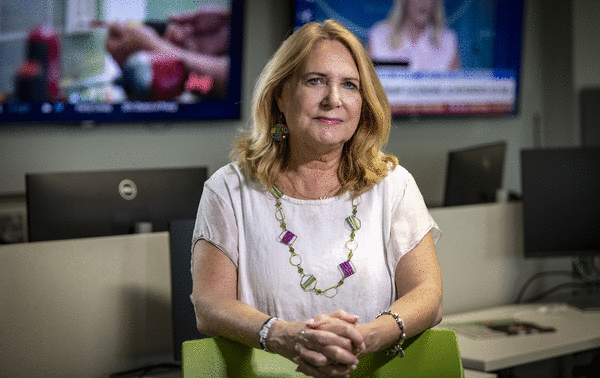
Miami Herald investigative reporter Julie K. Brown on Monday was honored by the Pulitzer Prize Board for her groundbreaking and impactful investigation into sex trafficker Jeffrey Epstein and the people and institutions that enabled him to abuse girls for decades.
The 2026 Pulitzer Prizes also recognized the Miami Herald and WLRN journalists as finalists in the Local Reporting category for their joint investigation into the systemic failures that made Florida’s Brightline the deadliest major passenger train in the nation.
“I could not be more proud of how hard our journalists work to bring such meaningful revelations to our community, or more grateful to have their accomplishments recognized by the Pulitzer board,” said Alex Mena, executive editor of the Miami Herald/el Nuevo Herald. “Both of these projects required extensive digging and drove positive change in our community and beyond.”
Brown’s honor is unique in that it recognizes not only her work from the past year, but the totality of her journalistic career and in particular her revelations about Epstein’s global sex-trafficking network and the people who protected him. Her explosive Epstein investigation, Perversion of Justice, ricocheted across the globe when it was published in 2018. Today, the so‑called Epstein Files have become an indispensable resource for journalists, researchers and investigators, revealing the scope of Epstein’s abuses, his connections to powerful figures, and the institutional breakdowns that allowed his crimes to persist.
Brown seized on a story and angle no other journalist saw and told that story in a way no other journalist had. She gave voice to Epstein’s victims and deep, relentless scrutiny to the making of a sweetheart deal that allowed a global sex-trafficking network to persist.
Her reporting centered on telling the stories of survivors whose allegations had been forgotten or ignored, and she worked patiently, sensitively to earn the trust of women wounded by Epstein. She documented how Epstein recruited vulnerable teenage girls, some as young as 14, at his South Florida mansion, grooming and paying them for sex and pressuring them to recruit other teens. These girls, now women, told Brown of cycles of exploitation at Epstein’s homes in Palm Beach, New York, New Mexico and on his private Caribbean island. Girls were scheduled, transported and isolated, with employees and close associates facilitating access and secrecy.
Brown wondered how such an expansive operation could flourish so openly, and how, given the evidence, Epstein got such a slap on the wrist in his first pass through the criminal court system. Her work exposed how Epstein escaped meaningful federal accountability for years, in part through a 2008 plea deal arranged by then-Miami U.S. Attorney Alexander Acosta, who President Donald Trump later elevated to secretary of labor. The deal allowed Epstein to avoid federal charges, serve minimal jail time and shield potential co‑conspirators.
Over months she documented detailed victim accounts and corroborated them by reviewing thousands of pages of sealed or overlooked police reports and court records, revealing patterns that had gone unexamined for years. Despite legal threats and resistance from Epstein’s lawyers, she pursued the story for more than two years, continuing to press for records and accountability.
Brown’s reporting helped revive federal scrutiny of Epstein. After the Herald published her series, Acosta resigned as labor secretary, Epstein was arrested on federal sex-trafficking charges, his accomplice Ghislane Maxwell was prosecuted and convicted, and Epstein victims won hundreds of millions of dollars in compensation.
That work began under then-Executive Editor Aminda Marques Gonzalez and is now overseen by Mena, who praised the reporting as “fearless, meticulous and driven by a commitment to give voice to people who were ignored for far too long.”
Despite the impact of Brown’s reporting on Epstein, her work was not recognized by the Pulitzer board in 2018, when her project was published, or in 2019, when its staggering impact became clear.
Brown credited the award to the survivors who trusted her. “This honor belongs to the women who trusted us with their stories,” she said. “Their voices made clear what had been hidden in plain sight, and they are the reason this work mattered.”
Brown worked closely on the project with visual journalist Emily Michot and then-Investigations Editor Casey Frank.
“We just had no idea when we went into it that anything of this magnitude would come out of it … that there was this whole wide world of evil out there,” said Michot, now retired. “Where would we be if (Brown) hadn’t done this, and if the Herald hadn’t supported this?”
Killer train
The Miami Herald and WLRN’s investigation into Brightline’s astonishing fatality rates was likewise impactful, immediately triggering the release of $42 million to improve safety along the tracks and challenging the narrative the victims were to blame, and nothing could be done.
The Killer Train investigation revealed that Brightline — a privately operated, higher-speed train promoted as a model for the future of American rail — has become the deadliest major passenger train in the United States. Since 2017, nearly 200 people have been killed by Brightline trains. That’s an average of one death every 13 days of service.
This team’s reporting proved false the widely accepted Brightline narrative that most of the dead were suicidal, or were drivers evading downed gates.
_____
©2026 Miami Herald. Visit miamiherald.com. Distributed by Tribune Content Agency, LLC.






Comments