Company behind proposed mine near the Boundary Waters has history of conflict with locals in Chile
Published in Science & Technology News
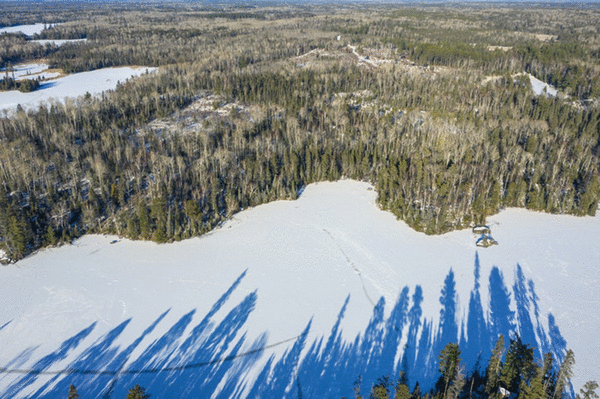
The big winner in the successful push to allow mining in Minnesota’s Superior National Forest is a company from Chile, led by one of the country’s richest families, with a business empire that stretches across transportation, food and entertainment.
Antofagasta, which owns the Twin Metals project that would mine copper, nickel and other metals just outside the Boundary Waters, still faces a years-long path before it can break ground. But scrutiny on the project, and the Chilean company behind it, is only increasing now that the underground mine has gained a lifeline.
“Who’s the winner here? You’re going to come down on the side of a Chilean billionaire,” Sen. Tina Smith said on April 16, as she urged her colleagues to vote against a measure to open up mining on 225,000 acres of federal lands. Ultimately, the resolution passed 50 to 49.
The wealthy Luksic family controls Antofagasta, named after the most important city in Chile’s arid mining region, and the place where Andrónico Luksic Abaroa, the late founder of the family business empire, grew up. He died in 2005, but his children continue to hold important positions in the family companies. His son Jean-Paul Luksic Fontbona remains the chairman of Antofagasta.
The company said in a statement that Twin Metals is “comprised of Minnesotans with extensive local expertise.” It’s also a piece of a much larger picture: Antofagasta is a top-ten producer of copper worldwide. In its four mines in Chile, the firm extracted 720,571 tons of copper in 2025.
The company has faced years-long legal battles with locals in Chile over environmental impacts at a waste disposal site for its flagship mine, Los Pelambres. Over the past 14 years, it has also attracted significant fines and sanctions from the country’s environmental watchdog, including a $2.3 million penalty for not correctly preserving archeological findings near one property (though that fine was later reduced).
In a statement, a spokesman for the company said that it was “a global leader in sustainable copper mining” and that “all copper from Antofagasta’s operations in Chile is certified with the Copper Mark standard.” Among other requirements, the standard means participating miners will use best practices to manage their waste and respect the rights of locals near their operations.
Multiple researchers and observers said that Antofagasta does not have a worse record than other firms operating in Chile, where a privatized system of water rights, separate from land ownership, allows mostly unchecked use by a notably water-hungry industry.
The combination of that water system and other facets in Chilean law that favor miners “adds up to not much restraint on full-bore economic development,” said Carl Bauer, a professor in the School of Geography, Development and Environment at the University of Arizona.
Antofagasta is not as scrutinized by the Chilean public as the larger, state-owned mining company Codelco, said Anita Carrasco, an environmental anthropologist from Chile who has researched mines’ community relations in the country for over two decades. But she predicted that the further the Twin Metals project progresses, the more attention will come to Antofagasta and its owners.
Antofagasta is one of many holdings of the Luksic family, which also owns Banco de Chile (the Bank of Chile), TV station Canal 13, a beverage company, railroads and vineyards.
Developing a mine in the United States is “going to bring some PR challenges they may or may not have thought about yet,” Carrasco said.
Chile produces roughly a quarter of the world’s supply of copper, and a portion of the country’s annual budget comes from Codelco’s profits. For that reason, the price of copper “is the barometer of the economy, basically,” said Aldo Madariaga, a professor of political science at Diego Portales University in Santiago, Chile’s capital.
Most of that copper is mined in the Atacama Desert, in the country’s arid north. In addition to Codelco, major miners like the Australian multinationals BHP and Rio Tinto; Swiss-based conglomerate Glencore; and Antofagasta all have mines in the region. Antofagasta is headquartered in London and listed on the stock exchange there, but all the sites it operates are in Chile.
According to the Luksic Family Foundation, at the end of his career, Luksic Abaroa, the patriarch who built the family’s businesses, said, “Throughout my life I’ve thought, ‘God, it can’t be that this desert is here for nothing, that there’s nothing here.’ I always thought it must contain something valuable.”
Northern Chile is already parched, and climate change has made conditions more extreme. Starting in 2010, parts of the country plunged into extreme dryness that has since been dubbed a “mega-drought.”
Putting mines in such a dry area has also put pressure on the country’s water reserves. Bauer said the country’s 1981 Water Code granted permanent rights to water that can be bought and sold separately from land. The system of trading rights has led to situations where small farmers near mines find their wells are running dry.
Many mining companies, including Antofagasta, are turning to desalination at the Pacific coast to mitigate their water problems. The company reported that in 2025, 63% of all water drawn by the mining division was from the sea.
Scott Odell, who researches large-scale mines’ community relations at MIT and George Washington University, said these plants helped reduce how much fresh water the mines need to withdraw. But they are not a “silver bullet” to solve water conflicts. Ideally, miners need to work on ways to use less water, and societies should think hard about how to build infrastructure that doesn’t need so many metals, he said.
In Minnesota, Antofagasta’s Twin Metals would face an almost opposite environmental pressure. The primary concern among conservationists there is that the mine would taint the region’s abundant lakes, rivers and wetlands with mine pollution. This interconnected, water-rich region could easily carry pollution to the Boundary Waters, they warn.
Most mines in Chile operate in the mountains, where ore is pulled out of the ground and then concentrated, Odell said. That concentrate, a slurry of copper, other metals and water, is then piped to the coast, where it is shipped out to be smelted in China, the global center of metal refining.
“Anywhere along that route, if there’s a leak in that pipe, then you’ve got contamination that’s entering the local water supplies,” Odell said.
Environmental groups say a 2009 pipeline leak at Antofagasta’s majority-owned Los Pelambres mine spilled more than 3,400 gallons of copper concentrate. The spill flowed into the nearby Choapa River.
“Los Pelambres performed monitoring and a full technical analysis to ensure there was no environmental damage,” Antofagasta said in its annual report that year.
The most publicized conflicts from Los Pelambres have been in relation to El Mauro tailings dam, an impoundment of mine waste and water in the Andean foothills, 35 miles from the mine. The opening of the dam in 2007 provided storage space for waste and helped extend the life of Los Pelambres.
But the dammed pool of mine sludge is just upstream of the small town of Caimanes. Its construction dried out the Pupio River that had flowed in the area, cutting off the village’s main source of water, according to a report in the Miami Herald.
In 2014, the Chilean Supreme Court ruled the damage had violated the rights of the people in the town, and the natural flow of the river had to be restored. Instead, the Herald reported, a protracted settlement negotiation that critics said was riddled with conflicts of interest led to payouts for many residents.
Caimanes residents are also concerned that the tailings dam could rupture in an earthquake, which would devastate the downstream village, said Odell, who has studied Los Pelambres mine.
Antofagasta says El Mauro dam is stable.
A few months after a Brazilian tailings dam spontaneously burst in 2019, Antofagasta put out a statement noting that El Mauro had survived an 8.3 magnitude earthquake in Chile in 2015, and it is monitored in real time for stability.
Odell, who has compared the impacts of different mines in Chile, said all the larger companies use similar practices and face similar pressures from the global market. Any new mine, he said, is environmentally and socially disruptive.
Across the board, “mining is a pretty dirty business,” he said.
At the same time, there’s more and more global demand for copper, a key ingredient in clean energy technology.
Corby Anderson, a professor of mine engineering at the Colorado School of Mines, said copper miners across the globe are dealing with lower grade ore and trying to find out how to produce more of the metal.
By looking in Minnesota and elsewhere for its next mine prospect, Antofagasta and the Luksics are “following the copper trail,” he said. The company is also developing several new sites in Chile and Peru.
“We want to do all these things like renewable energy and EVs; the thing that ties it all together is copper,” said Anderson, who once consulted with Antofagasta at Los Pelambres and another mine site the company has since sold.
Anderson said the industry is trying to move beyond massive tailings dams that store waste, an older technology. But Odell said it isn’t economically feasible to completely leave these structures behind, so companies are trying to avoid the least stable type of dam construction, which was used before the disaster in Brazil.
How innovation might show up in a Minnesota mine is still unclear. Twin Metals last submitted a mine plan in 2019 and suggested an alternative form of waste handling called “dry-stacking,” where tailings are placed on a liner. The company will have to start from the beginning with a lengthy environmental review once it solves a pending legal case related to its mineral leases.
“Any proposed Twin Metals project would be thoroughly scrutinized under a yearslong regulatory process by state and federal agencies before permits would be issued to begin construction of a mine,” the Antofagasta spokesman wrote in an email.
Anderson, who has met members of the Luksic family, said the company has a good reputation in the mining industry, and are sophisticated global operators.
“They’re not these junior miners that pop up and disappear,” he said.
©2026 The Minnesota Star Tribune. Visit at startribune.com. Distributed by Tribune Content Agency, LLC.





Comments