Commentary: 3 things we can learn from the Declaration of Independence
Published in Op Eds
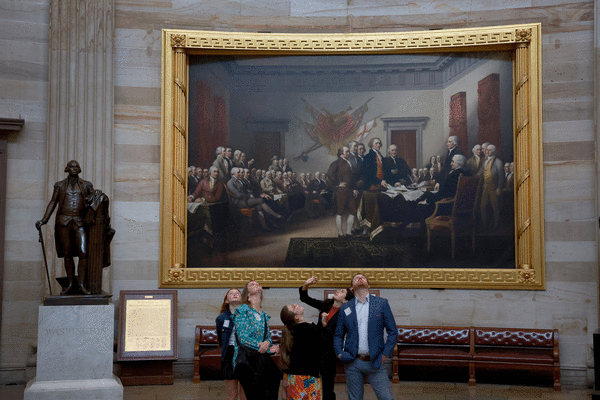
As a people, we feel lost. Our political life is full of division and animosity. Our society struggles to find its sense of meaning. Violence erupts far too often. And beyond our borders, we find ourselves embroiled in conflicts with enemies and allies.
We are a nation divided and adrift. Our Declaration of Independence can help us refocus on who we are and why we have a country. As we approach our 250th anniversary of the declaration, we should do more than celebrate; we should pay attention to what it has to teach us about ourselves.
Here are three things we can learn from our remarkable declaration:
First, the declaration reminds us that our purpose as a nation is grounded in the Laws of Nature and Nature’s God. Our rights to life, liberty and the pursuit of happiness are not a mere human “construct.” They are not an assertion of partisan interest or power. They are universal truths belonging to all human beings and having a divine source.
Thomas Jefferson does not explicitly link our rights to a specific religion, but he makes it clear that our natural equality and our rights come from nature and that nature has a God.
I worry that a growing number of Americans have forgotten that our rights have a divine source. In fact, most people have stopped referring to “natural rights” and have substituted the term “human rights.”
Consider what this means. If our rights are not actually natural, what is their foundation? If we use the term “rights” to describe things that we want for ourselves, then they have no status beyond our desire to have them. They cease to be rights and are reduced to the level of “wants,” as in “I want life, liberty, and the pursuit of happiness.”
However, the wants of one person have no special claim to legitimacy. There is no reason that they should be respected. In other words, if we take Nature and Nature’s God out of the equation, rights cease to exist. You cannot deny the idea of objective truth and then demand that your rights be respected.
Our declaration reminds us that our rights are grounded in something greater than ourselves. Their status transcends ordinary wants or desires.
Second, our declaration reminds us that politics is about protecting rights. It is not about promoting one political agenda or another. It is not about “winning” in a competition between one political party and another.
In Walter Isaacson’s book on the declaration, “The Greatest Sentence Ever Written,” he talks about the central importance of finding what he calls “common ground,” which is just another way of referring to our need for shared beliefs and principles.
The declaration can inspire us to rediscover that common ground. People who disagree with us are not the enemy. We all share fundamental rights — as the declaration puts it — that governments are instituted among men to protect. That is our goal. That is the reason for politics. In our polarized society, this idea can be healing if we allow ourselves to embrace it.
And finally, the declaration reminds us that our foreign policy has the same essential purpose as our domestic policy: promoting natural rights. The truths of the declaration are universal truths, applying to all people at all times. We do not engage with other countries or wage war for our benefit. We do not seek profit at the expense of others.
The declaration reminds us that there is a moral purpose to who we are as a nation, and it can guide us in our relations with others. We do not seek a narrow national interest. Our purpose is not to gain economic advantage. We have a mission in the world: to live by the principles of our declaration and to promote the natural rights of others. The declaration can reawaken the idea that America can be a moral force in this world.
This is not a “pie in the sky” approach to foreign policy. The declaration does not counsel us to be naive or stupid. It does remind us that mere realpolitik is misguided and ultimately self-defeating. If the United States does not stand for the power of universal principles and the natural rights of all people, then we have no special claim to exist. We will have become nothing more than a bully on the international stage.
This is the time to remind ourselves of what is truly great about our Declaration of Independence. It has the power to inspire us to find a way to renew what is best about our country.
_____
ABOUT THE WRITER
Solomon D. Stevens is the author of “Religion, Politics, and the Law” (co-authored with Peter Schotten) and “Challenges to Peace in the Middle East.” He wrote this for InsideSources.com.
_____
©2026 Tribune Content Agency, LLC.

















































Comments