Idaho's trans athlete case is heading to the US Supreme Court. What to know
Published in Political News
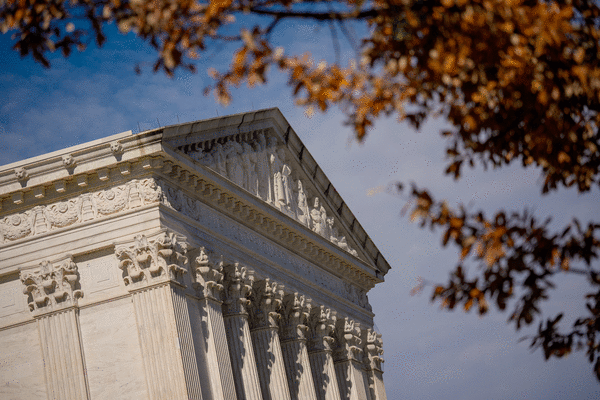
BOISE, Idaho — The U.S. Supreme Court will hear arguments Tuesday on a challenge to Idaho’s law banning transgender women and girls from participating in sports that align with their gender identity.
Idaho in 2020 became the first state in the country to categorically bar trans women and girls from women’s and girls sports teams after Gov. Brad Little signed the bill into law. Shortly after, Lindsay Hecox, a transgender woman who at the time was a freshman at Boise State University, and a cisgender high school student sued.
The case, Bradley Little, et al. v. Lindsay Hecox, et al., has since gone through years of litigation. More than 25 other states have passed their own laws targeting trans athletes, according to the Williams Institute at UCLA School of Law
Last year, the highest court in the nation said it would take up the issue. On Tuesday, both sides will present their arguments in Washington, D.C. A ruling likely will come later this year. Opinions are traditionally released by the last day of the court’s term, when they take a recess for summer in late June or early July, according to the Supreme Court’s website. Opinions that are unanimous are normally released sooner than more controversial opinions.
How did we get here?
Hecox had long been passionate about running and loved being part of a team, she said in a 2020 declaration filed in support of a preliminary injunction. She had experienced gender dysphoria in grade school, but didn’t have the words to describe what she was feeling, the filing said.
She began gender-affirming hormone therapy after high school and hoped to compete in track and cross country in college.
“I just want to run with other girls on the team,” Hecox said in a 2020 press release from the American Civil Liberties Union, one of the organizations that filed the lawsuit on behalf of Hecox. “I run for myself, but part of what I enjoy about the sport is building the relationships with a team. I’m a girl, and the right team for me is the girls team.”
Days after she filed the suit, an Idaho judge issued a preliminary injunction blocking the law from taking effect. In 2023, the U.S. Court of Appeals for the 9th Circuit upheld an injunction against the law after a district judge found that it was likely unconstitutional. The appeals court has flipped on whether to allow the full scope of the injunction since then, a marked shift that displayed the impact of a high court decision in another case. Ultimately, the appeals court affirmed the district court’s grant of a preliminary injunction to Hecox, but vacated the injunction applied to the rest of the state.
She tried out unsuccessfully for the Boise State track and cross country teams but competed in club women’s soccer, according to court documents.
The state of Idaho asked the Supreme Court to hear the case, and this past summer the court agreed to review it. Idaho Attorney General Raúl Labrador said in a news release at the time that women and girls “deserve an equal playing field,” men and women are “biologically different” and activists are pushing an agenda that would “ultimately sideline women and girls in their own sports.”
In September, Hecox filed a notice to dismiss the lawsuit. In the request, her attorneys said if she continued with the case, she would face more harassment that would impact her health, safety and ability to graduate. The ACLU said Hecox isn’t participating in any women’s athletic programs covered by the bill and wants to prioritize finishing her degree at Boise State.
A federal judge in October denied that request, saying the state has a “fair right to have its arguments heard and adjudicated once and for all” and that dismissing the case would leave “critical questions in limbo.”
The U.S. Supreme Court said in an October filing that the request that the court dismiss the case as moot would be deferred pending the oral arguments.
Supreme court to hear second case over trans athletes
The U.S. Supreme Court will also hear a similar case Tuesday about a West Virginia teenager whose family challenged a state law requiring students to participate in sports that correspond with their sex assigned at birth. Both cases ask whether the laws violate the Equal Protection Clause of the Fourteenth Amendment.
Labrador said Thursday on a call with reporters that Idaho’s law ensures “fairness, safety and equal athletic opportunities for girls and women.”
“The Constitution permits states to recognize biological differences and preserve women’s sports for female athletes, and Idaho’s law does exactly that,” he said. “The Supreme Court’s trying to decide whether Idaho can preserve women’s sports based on biological sex, or must female be redefined based on gender identity.”
He added that “common sense dictates what the results should be.”
Josh Block, senior counsel with the ACLU’s LGBTQ & HIV Projects who will be presenting arguments in the West Virginia case, laid out what he said was the fundamental question.
“If the evidence shows that our clients, by virtue of their medical care, have eliminated or prevented any of the physiological differences that give rise to athletic advantages between men and women, is it legal for West Virginia and Idaho to still say that they can’t play sports as who they are?” he said during a call with reporters.
Block said these cases could have far-reaching consequences on trans rights more broadly.
“Idaho wants to use this case as a jumping off point for establishing a really broad principle that the government can discriminate against transgender people in all contexts,” he told reporters Thursday.
Idaho has history of laws targeting trans people
Over the past several years, the Idaho Legislature and lawmakers across the country have passed a series of bills targeting transgender youth and adults, several of which are now being litigated.
In Idaho, legislators have passed laws that bar transgender children from accessing gender-affirming care; prohibit teachers from using pronouns that differ from a student’s sex at birth without parent approval; and bar trans youths from using bathrooms that corresponded with their gender identities.
Trans rights have become a divisive issue across the country and have been amplified by President Donald Trump’s administration. Just about 1% of people 13 and older across the country identify as transgender, according to estimates from the Williams Institute.
Sasha Buchert, a senior attorney in the Washington D.C. office of Lambda Legal, an organization that advocates for the rights of LGBTQ+ people, said before these issues became a “political flashpoint,” transgender students had been participating in sports across the country “without incident.” She warned that laws like these lead to a culture of suspicion and gender policing.
“We’re increasingly hearing about non-transgender students and athletes being questioned or accused based on their appearance or their athletic ability, which is a predictable consequence of laws that encourage scrutiny of young people’s bodies and identities,” she told reporters Thursday.
In fact, the Jane Doe who joined Hecox’s lawsuit against Idaho worried about exactly that. The initial complaint filed in 2020 said she “fears for her privacy and security, both emotionally and physically, if she continues to play sports” and worries that a competitor might “dispute” her sex.
In April of last year, the Idaho High School Activities Association banned transgender athletes from girls sports after an executive order from Trump reinterpreting Title IX, according to previous Statesman reporting. The NCAA did the same.
According to the Trevor Project, an organization that advocates for LGBTQ+ rights and conducts a survey on the mental health of young people, trans teens who attended schools with policies supportive of gender transitions have lower rates of attempting suicide.
The U.S. Supreme Court has previously taken up other cases involving laws targeting trans people. Last year, the court upheld a Tennessee law banning gender-affirming care for minors — a ruling with repercussions across the country.
Block acknowledged these cases will be an “uphill fight.”
“We also hope that regardless of what happens, this case isn’t successfully used as a tool to undermine the rights of transgender folks, more generally, in areas far beyond just athletics,” he said.
©2026 The Idaho Statesman. Visit idahostatesman.com. Distributed by Tribune Content Agency, LLC.


















































Comments