From cutting trees to helping Oneil Cruz: Why Tony Beasley's Pirates return 'was not a coincidence'
Published in Baseball
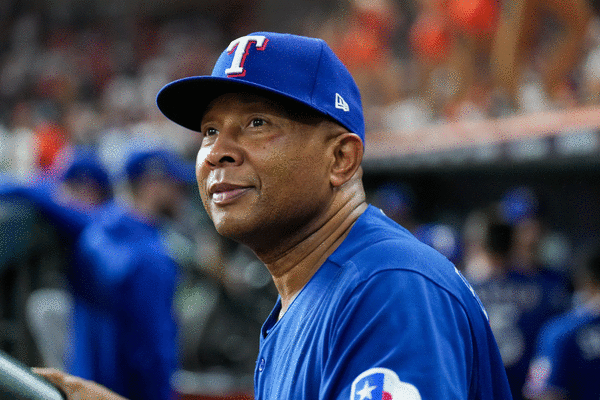
PITTSBURGH — Sensing the Texas Rangers would likely not renew his contract this offseason, Tony Beasley thought this could be it. He'd turn 59 in December. After more than three decades in professional baseball, Beasley and his wife Stacy began to discuss their next chapter.
Then Pirates manager Don Kelly called.
Beasley and Kelly shared a short time with the Pirates, but mostly there was a mutual respect developed while competing against one another in the minor leagues, Beasley managing Double-A Altoona in Pittsburgh's system, Kelly playing in Erie during his time with the Tigers.
Kelly had apparently heard Beasley — who had been the Rangers' third-base coach for the past 10 years — was contemplating retirement and Kelly came armed with a request.
OK, a demand.
"It was weird," Beasley said. "Two hours after I spoke with the Rangers, [Kelly] called and said, 'Don't start taking that pension yet.' ... He didn't even know I talked to them. It was not a coincidence in my mind."
That random succession of events, as well as the Pirates' talented young pitching staff and offseason plan, are a few of the reasons why Beasley ultimately decided to return for a third stint with the organization, joining Kelly's staff in December as third-base coach and outfield instructor.
It's a move that with Beasley's experience, knowledge and ability to coach should work out well for both parties.
Beasley joined the Pirates as a player via trade in September 1991, spent six seasons in their minor league system and went directly into coaching with Pittsburgh in 1999.
After leading short-season Williamsport to a championship in his first season as manager in 2001, Baseball America named him its manager of the year at Low-A (twice) and Double-A (once) each of the next three years.
Beasley left in 2006 to coach third base for Frank Robinson with the Nationals but returned to Pittsburgh the following season, working on the big-league staff from 2008-10 and losing his job when John Russell was fired. There was another Washington return for Beasley from 2011-14.
The time in Texas was great — working with longtime Pirate Jeff Bannister, managing on an interim basis in 2022 and winning the World Series the next season — but Beasley also knew changes were coming with Skip Schumaker taking over as manager.
Similar to what Ryan O'Hearn said during his introductory press conference Thursday, that conversation with Kelly changed Beasley's mind and convinced him to keep going.
"It was that and the familiarity with the organization," Beasley said. "I still know a lot of people there. I had other organizations talking with me, but I felt like Pittsburgh was the right spot.
"I just love where the organization is at. I know we need to improve in some areas, but I thought, 'Man, this could be an opportunity to be part of something great, to go somewhere and really make a difference.'"
'I enjoy it'
In turn, it seems the Pirates got the world's most interesting man. Or something like that.
Along with being universally respected around the game, Beasley is a fascinating character. He was born in a tiny Virginia town (Sparta) about 50 minutes north of Richmond and now spends his offseasons only about 10 minutes away in Bowling Green.
There's a reason for that. Instead of using the offseason to soak up sunshine on a beach somewhere, Beasley runs chainsaws and drives heavy equipment working for the family business, Beasley Tree Harvesting.
"I enjoy it," Beasley said. "That my father's business. I have four brothers. They all do it.
"I get home, I have no choice. They're not gonna let me sit at home while they're out there working. Plus, I couldn't sit at home anyhow."
Depending on what a land owner wants, the Beasleys will clear out full sections of land, zipping off limbs and delivering the timber to a logging site. It's hard work, but Beasley loves it.
Beasley is also an accomplished singer. He used to be in a traveling choir, was approached about joining a jazz group in D.C. and sings every Sunday in church during the offseason. In Texas, Beasley sang the national anthem before several Rangers games, something the Pirates will surely reprise this summer at PNC Park.
"I started when I was probably 10-11, singing with grownups," Beasley said. "I don't know. I've just always loved it."
The last part of Beasley's off-field story is the least exciting: cancer. He was diagnosed with rectal cancer in February 2016 and missed the start of that baseball season for treatment. However, he was declared cancer-free that December and loves using his story to encourage or calm others.
That starts with cancer-related initiatives and charities. But it also includes smaller, quieter acts like speaking with people he's never met who've been diagnosed and fear the consequences.
"People will give me a name and number, and I'll call 'em and talk to 'em because that's a part of my journey," Beasley said. "By faith, I got through it. I thank God for healing me and bringing me through that situation. It's part of my story and platform. It also gives me purpose."
"The human being that he is and what he stands for ... just a great baseball guy," Kelly said. "Really excited to bring him back."
'Not going to waver'
Beasley chose to return to Pittsburgh because he sees promise here. But spoken like a true lumberjack, he's also excited about the work.
Coaching third base will be one thing. Beasley, Kelly and others have talked about the Pirates needing to be aggressive and use their athleticism on the bases. But a bigger part of Beasley's job describe is ... well, big: 6-foot-7 Oneil Cruz.
It could become a flashpoint for the 27-year-old's career, at least as it pertains to playing center field, as well as the inconsistency and lack of focus that has plagued Cruz.
In true teacher form, Beasley — who met Cruz this past season via Dennis Santana — can't wait for the challenge.
"He seemed like a very personable kid," Beasley said. "He's super talented, but I think he needs some direction and accountability.
"That's the type of thing I enjoy doing. I embrace that. From a coaching standpoint, what more could you want? There's an opportunity to take a player who has the potential to be great and get him to greatness. That's the most gratifying part of coaching."
Beasley was only getting started. He continued by comparing Cruz to Adolis Garcia, a player he worked with more than anyone in Texas.
In 2020, Garcia was a raw, 27-year-old Cuban defector the Rangers picked up from the Cardinals. He survived on talent. Defensive details lacked. Beasley challenged Garcia to win a Gold Glove — and he did in 2023.
The coach sees the same sort of potential in Cruz, but there's a catch.
"It's a day-in, day-out approach," Beasley said. "It's not, 'I'll just make a couple good plays a week, then I'll do some bonehead stuff, and people will let it slide.'"
It's that level of coaching that drew Beasley back, the same stuff that has motivated him throughout his career and led Neil Walker to call him "one of the best baseball people/humans" he's ever met.
Everyone loves the guy, especially the millionaires the blue-collar Beasley is entrusted to help.
"It's about building the right relationship with that player, to where I can hold him accountable to playing the game at a certain level," Beasley said. "Players understand that. When I'm holding them accountable, it's not about me, it's about them.
"It's about a player doing what he's capable of doing for his teammates, definitely for his pitching staff. I'm not going to waver with what the standards are. I'll get him to a point where he can eliminate me and go play."
____
© 2026 the Pittsburgh Post-Gazette. Visit www.post-gazette.com. Distributed by Tribune Content Agency, LLC.




Comments