Maryland secures Preakness brand for $85M, matching Churchill Downs offer
Published in Horse Racing
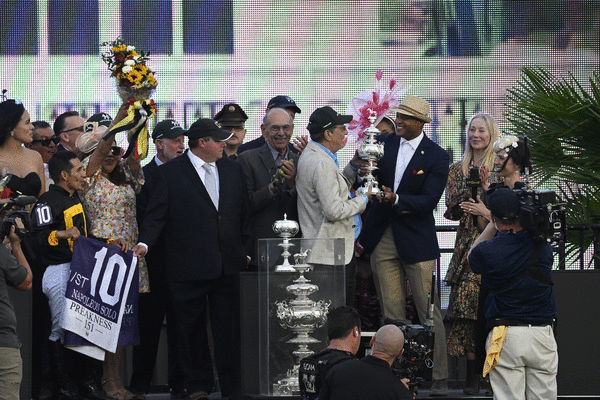
BALTIMORE — Gov. Wes Moore’s administration announced Thursday that Maryland will secure control of the Preakness Stakes’ intellectual property, matching an $85 million offer by Churchill Downs and ending months of uncertainty over the future of the Triple Crown event.
“The Preakness Stakes is more than just a race; it is a cornerstone of Maryland’s history, culture, and economy,” Moore’s office said in a statement that outlined the decision. “Our administration has made historic investments to revitalize Pimlico Race Course and secure the long-term sustainability of the Maryland horseracing industry. This decision secures a vital asset for our state, allows Maryland to shape its horseracing destiny, and by leveraging the Preakness’s iconic status and partnering with industry experts to enhance the fan experience, preserve Maryland’s position as a key power player in the Triple Crown for generations to come.”
The Preakness has moved between state entities and 1/ST Racing, which operated this past spring’s race at Laurel Park because of renovations at Pimlico Race Course.
Historically, Maryland has leased the intellectual property rights for the middle jewel of the Triple Crown, including all branding and trademarks. That arrangement has left the state in a vulnerable position, requiring a $400 million investment to renovate Old Hilltop while leasing the rights from a third party.
“By owning the IP, the State will no longer be subject to the disadvantageous fee structure of the existing exclusive licensing agreement, which would have escalated costs for the State over time,” the statement from Moore’s office reads. “Instead, the State will operate under a model that prioritizes industry health and community benefit, consistent with the nonprofit model adopted by the Maryland Jockey Club.”
In a text to The Baltimore Sun, House Minority Leader Jason Buckel called the move an “idiotic decision.”
“Wasting more taxpayer dollars for foolish reasons,” he wrote, “rather than pursuing a meaningful long-term relationship with Churchill Downs, who already operates a Maryland racetrack and casino, to eventually create a partnership to make the Triple Crown races more successful and lucrative for the betterment of the industry and Maryland.”
Republican Del. Kathy Szeliga added: “Why do taxpayers have to shovel out another $85 million? [Moore] rushed to get the deal done, so he could go on national news and talk about this great deal he made to take over this 110-year-old dilapidated horse racing facility from the Stronach Group, but he didn’t negotiate the important part of that horse racing facility, which is the Preakness, the name and intellectual property of the Preakness.”
According to the statement from Moore’s administration, the acquisition will be funded through a tax-exempt revenue bond issuance by the Maryland Economic Development Corporation (MEDCO), and no general fund tax dollars will be used. The debt service will be backed by future revenues from the Preakness Stakes and the Black-Eyed Susan, including wagering, ticketing and sponsorships.
Daraius Irani, an economics professor at Towson University, said Maryland “has a challenging environment for businesses,” so incentives are crucial to attracting and retaining new businesses in the state. Irani added that the state seems financially well enough to pay off the bonds funding Preakness’ rights.
“The ticketing and the gambling should be enough to pay it off,” Irani said. “They’re just borrowing the $85 million against future revenues, and they’ve done the math, and hopefully the math is somewhat conservative. They figured out that the revenue stream under conservative estimates is sufficient enough to pay for the bond over the life of the bond.”
Jim Rosapepe, a Democratic state senator who represents parts of Anne Arundel and Prince George’s counties, told The Sun last month that he saw a potential move to buy the Preakness’ intellectual property rights as “ridiculous.”
After hearing the news on Thursday, he said he wasn’t totally opposed to the idea, but that he wanted to take a closer look at the details of Moore’s proposed deal. Rosapepe said that state lawmakers hadn’t heard about it until Moore’s team announced it on Thursday.
“The risks are worth trying to protect against, it’s just about figuring out, how much do we want to spend,” Rosapepe said. “Either way, in the grand scheme of state economic development … it’s an issue but it’s not a big issue.”
Maryland Sen. Justin Ready, a Republican who represents parts of Carroll and Frederick counties, said the deal caught him off guard.
Ready, the Senate minority whip, said he believed Churchill Downs and the state were working toward a long-term agreement to preserve the Preakness Stakes.
Now, he said, the state is “jumping ahead of the private sector” to buy the rights to the Preakness intellectual property. At the same time, he said, the state faces a budget deficit, has cut state disability services and has raised taxes “exponentially.”
“The governor’s decision-making always seems to be aimed at making a splash,” Ready said.
JP Krahel, an economics professor at Loyola University Maryland, supported Maryland pursuing business deals that pay for themselves, calling the Preakness acquisition “tidy business.”
“This isn’t one of those cases where we make an investment into something where the payoff is [unknown] like reducing prisoner recidivism,” Krahel said, noting that social welfare programs are still worth investing in. “That’s a great idea, but we don’t make money off of that in the same way we make money off the Preakness.”
Next year’s Preakness is expected to return to Pimlico, with enough of the renovation completed to host the racing weekend, and a complete overhaul scheduled to be finished in time for 2028. Maryland Jockey Club president and general manager Bill Knauf said in a statement that the organization “will work with our strategic partners on exciting new events and entertainment options leading up to Preakness weekend.”
In Moore’s letter to 1/ST and Churchill, he affirmed a hope to “unlock growth and drive innovation to benefit the Preakness Stakes, Maryland’s horseracing industry, and the entire Triple Crown.”
———
Adam Bednar contributed to this article.
©2026 Baltimore Sun. Visit baltimoresun.com. Distributed by Tribune Content Agency, LLC.



Comments